

 About 18th Digitech
 Awards and Credentials
 Our Partners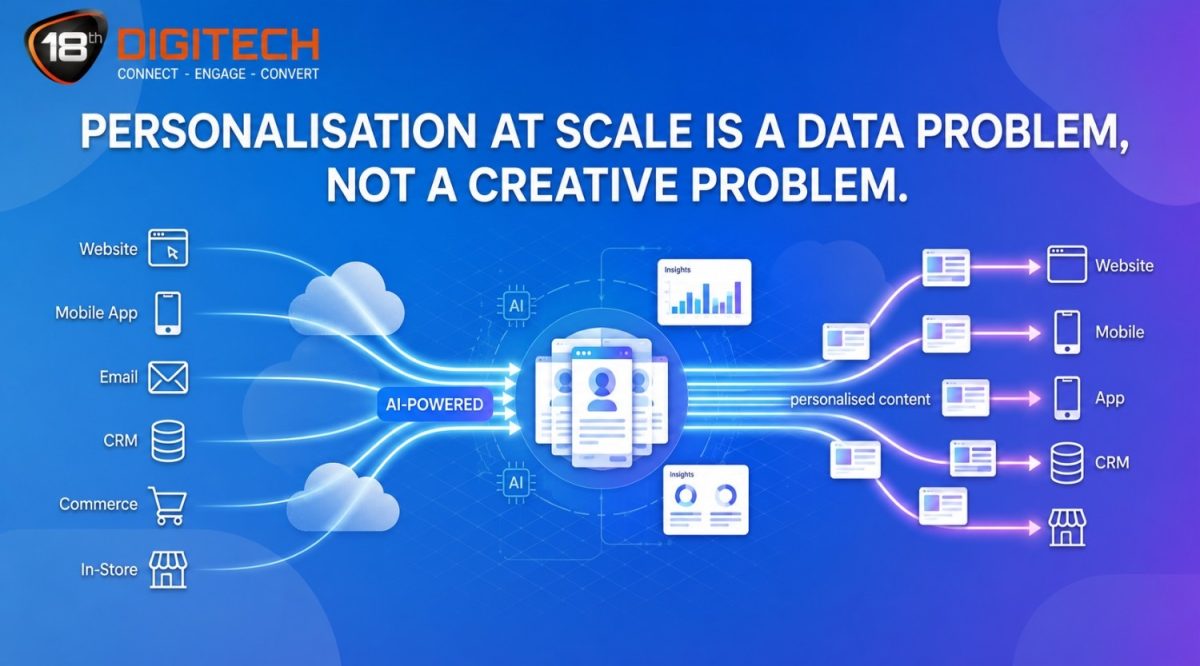
The customer changed their mind three clicks ago. Your personalisation engine is still showing them what they wanted last week.
That is not a creative failure. That is a data failure. And until brands stop treating personalisation as a content problem, they will keep throwing creative budget at something that was never a creative problem to begin with.
The unlock was always the data. It still is.
More Content Was Never the Answer.
Personalisation became synonymous with variants. More designs. More copy. More versions of the same message for more audience slices.
Brands built entire teams around content volume, hoping the right message would find the right person somewhere in all that output. It rarely did.
Because the problem was never what you were showing. It was how well you knew the person you were showing it to. A brand that knows its customer deeply needs fewer variants. A brand that does not know them needs infinite ones and still gets it wrong.
Volume without precision is just noise with better branding.
A Profile Scattered Across Ten Systems Is Not a Profile.
Purchase history in one place. Browsing behaviour in another. Email engagement somewhere else. In-store data in a system nobody has opened in months.
Ten systems. Ten incomplete versions of the same person. None of them talking to each other in real time. That is not a customer profile. That is a liability dressed up as data infrastructure.
You cannot make confident personalisation decisions about someone you only partially know. And right now most brands only partially know almost everyone on their list. They just do not say it out loud.
Segments Tell You Who Someone Was. Real-Time Tells You Who They Are Now.
A segment built on last month’s purchases and last quarter’s browsing is not targeting. It is archaeology. It tells you where someone has been, not where they are heading.
By the time your audience refreshes, your customer has already decided. Already bought. Already formed an opinion about whether your brand actually understands them or just thinks it does.
Real-time behaviour is the only signal that tells you who someone is right now. With intent you can act on before it disappears into the next tab they open.
Unified Data Without Content Is an Engine With No Fuel.
This is where personalisation quietly stalls for most brands. The profiles get unified. The signals start flowing. The data team celebrates. And then the content supply chain cannot keep up with what the data now knows.
The engine is running. There is nothing to serve.
Both sides have to be ready at the same time. Real-time data tells you who to reach and when. Creative tells you what they actually experience when you do. Neither works without the other and most brands have only ever fixed one side while wondering why the other keeps failing.
The Foundation Has to Be Built for Real Time. Not Retrofitted for It.
Most brands did not build their data infrastructure for personalisation. They built it for reporting. And there is a fundamental difference between a system designed to tell you what happened and a system designed to act on what is happening right now.
Retrofitting is not the answer. A customer signal that takes four hours to reach the decisioning layer is not real time. It is delayed targeting with a better name.
The brands getting personalisation right built a foundation where data moves the moment behaviour happens, where profiles update instantly and where the content layer is connected closely enough to act before the moment passes.
That is not a creative capability. That is infrastructure. And without it no amount of variants, no algorithm and no campaign will close the gap.
The Brands Winning Did Not Produce More. They Finally Knew More.
One unified profile. Real-time signals. A content supply chain built to keep pace with what the data is telling you.
That combination makes personalisation feel effortless to the customer and compounding to the business. Every interaction makes the next one sharper. Every signal adds to a profile that gets more useful over time.
The creative brief still matters. It just only matters after the data problem is solved.
You cannot show the right thing to someone you do not really know. No amount of design budget changes that