



 About 18th Digitech
 Awards and Credentials
 Our Partners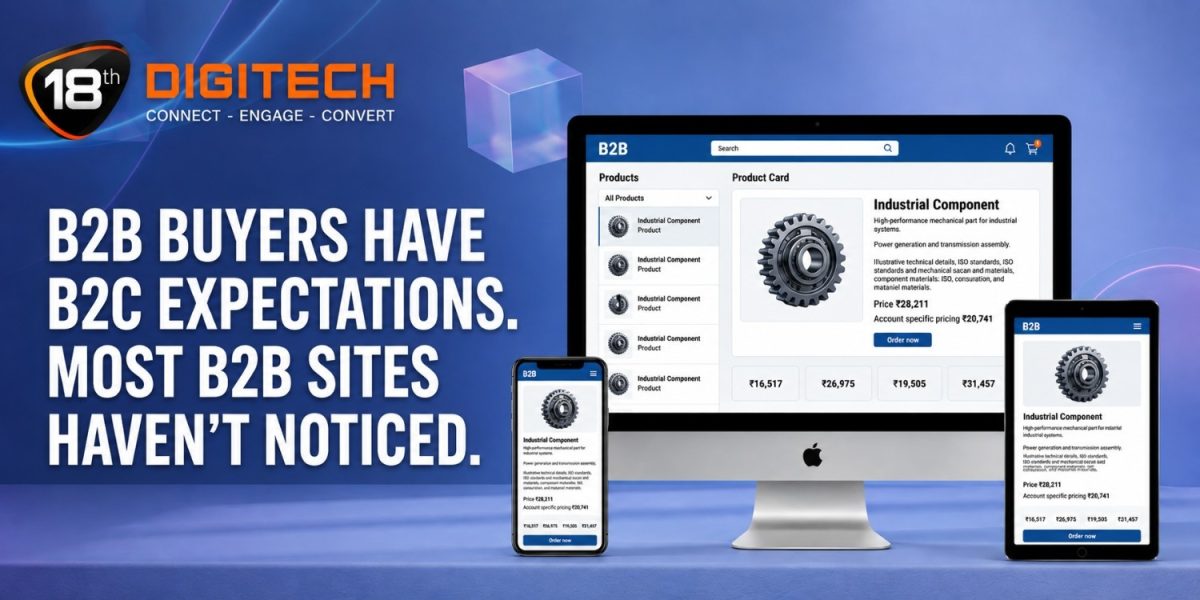
B2B brands tell themselves their buyers are different. More patient. More relationship-driven. More forgiving of a clunky portal. They are not. They never were.
The same person approving your quote on Monday morning ordered from three consumer sites on Sunday night. They did not develop more patience between Sunday and Monday. They just stopped expecting you to match the experience. And that quiet resignation is costing you more than any lost tender ever will.
The B2B Buying Journey Starts Without You.
Before your sales team makes a single call, the buyer has already searched, compared and formed a view. Not a tentative one. A firm one.
Your site either made that journey easy or complicated it. And in most B2B businesses, the honest answer is complicated. Pages built for internal processes. Navigation designed around categories nobody uses. Information hidden behind forms nobody wants to fill.
The buyer did not complain. They just moved further down the shortlist without telling you.
Contact Us For Pricing Is Not a Strategy. It Is an Apology.
Hiding pricing behind a sales call made sense when information was scarce and relationships were the only route to market. Neither of those things is true anymore.
Your buyer found three alternatives before they reached your contact form. They compared features, read reviews and built a business case. What they needed from your site was a number. What they got was a delay.
Pricing complexity is real in B2B. But complexity is not a reason to keep buyers in the dark. It is a reason to build something smart enough to show them exactly what they need to see, at the moment they need to see it.
Every Unnecessary Step Is an Exit Your Buyer Will Take.
A buyer who cannot find their price without submitting a request does not wait. A buyer who cannot check stock without calling an account manager does not call. They find a supplier whose site answers the question without asking them to slow down first.
Self-service in B2B is not a preference. It is the default behaviour of every modern buyer. They want to get as far as possible before they speak to anyone. Not because your sales team is unwelcome. Because their time is not negotiable.
Every friction point is a quiet signal that doing business with you costs more effort than it should. Most buyers do not say that out loud. They just act on it.
The B2B Product Page Is Not a Brochure. It Is the First Meeting.
A buyer on your product detail page is not browsing. They are evaluating. And they are doing it alone, without a rep, without a call and without the patience to come back later if the answer is not there right now.
Specs. Live stock. Account-specific pricing. Contract terms. All of it on one screen without a form in the way.
The brands that have rebuilt their product pages around that moment are closing deals that never reach a sales conversation. Not because the sales team failed. Because the site already did the work before anyone picked up the phone.
The Brands Winning Are Not Selling Harder. They Are Making It Easier to Buy.
Speed. Transparency. A digital experience that respects the buyer’s time rather than redirecting it through a process built for the supplier’s convenience. That is what separates the B2B brands pulling ahead from the ones wondering why their pipeline keeps stalling.
Account-based personalisation. Self-service contracts. Real-time inventory. Pricing visible to the right buyer at the right moment. These are not advanced capabilities anymore. They are the baseline expectation of every buyer who spent last night on a site that already delivers all of them without being asked.
The brands that have built this experience are not just winning more deals. They are winning them earlier, faster and with far less sales effort than their competitors are spending to close the same size order.
The Deal Was Lost Before Your Sales Team Knew There Was One.
Most B2B brands measure what happens inside the sales process. Almost none measure what happens before it. That is exactly where the real losses are sitting. Silent. Invisible. Never appearing in a pipeline report because they never made it into the pipeline at all.
Fix the digital experience and the deals do not just close faster. They start from a completely different place. From buyers who arrived informed, found what they needed and moved forward without anyone having to chase them.
Your buyer was not lost to a better product. They were lost to a better website. And that is the easiest problem to fix once you decide it is worth fixing.