

 About 18th Digitech
 Awards and Credentials
 Our Partners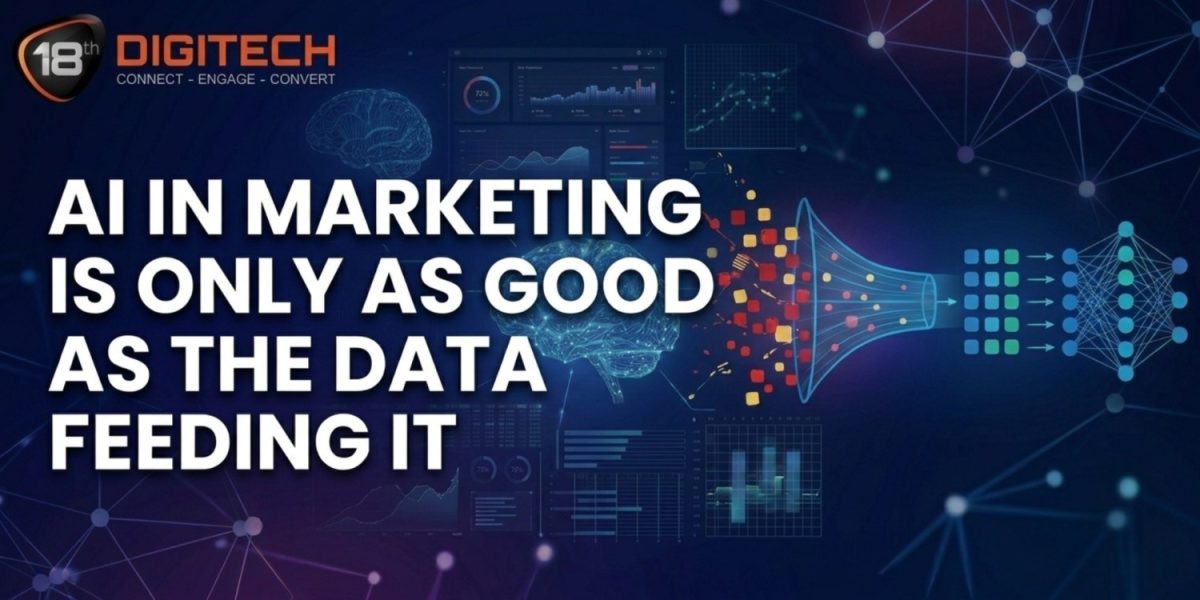
Somewhere right now, a marketing team is celebrating their new AI platform. They have no idea it’s running on data that’s two years old, full of duplicates, and missing half the picture. The results will tell them. Eventually.
Most AI strategies skip right past the one thing that determines whether any of it works. Not the vendors. Not the consultants. Not the teams who just signed a twelve-month contract. But it’s the only conversation that actually matters because AI in marketing is only as good as the data feeding it.
What Goes Into Your AI Determines What Comes Out of It
Your AI doesn’t think. It repeats.
It finds patterns in the data you give it. Then it scales those patterns fast, confidently, and at full budget. Give it clean, accurate customer data and it performs. Give it outdated records, duplicate contacts, and broken signals and it makes the wrong call, at speed, every single time.
The tool isn’t the problem. The data going into it is.
First-Party Data Is Now Your Most Valuable Marketing Asset
For years, brands treated first-party data like a compliance task. A box to check. A task to hand off. Nothing more.
That thinking is expensive now.
Third-party tracking is gone. Platform targeting has become unreliable.
What remains is the data your customers share directly with you through purchases, emails, product usage, and real interactions. That’s the signal your AI runs on.
If that data lives in five different places and nobody owns it your AI is personalising based on guesswork.
Data Governance Isn’t an IT Job, It’s a Growth Job
Most marketing teams hand data governance to the tech team. Then wonder why their AI keeps getting it wrong.
When your customer data platform is stitching together three versions of the same person and calling it a segment every campaign built on top of it is already off. The targeting is off. The messaging is off. The spend is off.
Clean data governance is what gives your AI a single, accurate picture of each buyer. Without it, you’re not running AI marketing. You’re running expensive guesswork.
Bad Data Doesn’t Just Waste Budget, It Misdirects It
Duplicate records. Stale contacts. Misread conversions. These aren’t admin problems. They’re budget problems.
When your AI reads broken attribution data, it sends your money toward the wrong channels. It doesn’t fail quietly. It fails with confidence because that’s what it was trained to do.
Predictive AI needs thousands of clean, accurate examples to build models worth acting on. Without data hygiene as a discipline, you’re not building prediction. You’re building noise.
Segmentation Breaks When Identity Breaks
One customer. Five email addresses. Three device IDs. Two phone numbers. All logged separately.
Your AI sees five different people. It targets all five. Your personalisation falls apart not because the model is weak, but because the inputs are wrong.
Identity resolution is what brings those signals together into one accurate customer profile. It’s what allows your AI to understand who your customer actually is right now, not a year ago.
Without it, your AI is learning the wrong lessons and acting on them at scale.
The Best AI Marketing Strategy Starts Before You Pick a Tool
Most brands get this backwards. They invest in the model first. Then they discover the inputs aren’t ready. Then performance plateaus and nobody knows why.
Your data strategy should be decided before a single AI vendor enters the room. What data do you collect? Where does it live? How accurate is it? How is customer identity resolved across channels?
These aren’t IT questions. They’re growth questions. And the brands winning right now answered them first.
Your Customer Changed Yesterday. Does Your AI Know That?
Static data isn’t enough. Your customer browsed a competitor this morning. They opened your email but didn’t click. They downgraded last week.
If your AI doesn’t know that yet it’s talking to a version of your customer that no longer exists.
Real-time data pipelines give your AI a living picture of each buyer one that shifts with behaviour and updates with intent. That’s what makes personalisation feel relevant instead of random.
The brands closing the gap between signal and action are the ones customers actually feel understood by.
AI Personalisation at Scale Only Works With Clean Data
Every AI vendor promises personalisation at scale. And the technology can absolutely deliver it.
But personalisation built on poor customer data is just noise with a name attached. Messages sent to the right segment, with the wrong information, at the wrong moment, about a relationship your brand has misread.
Clean, unified customer data is what turns that promise into performance. Not eventually. Measurably.
One Question Worth Asking Before Your Next AI Investment
Before the next vendor demo. Before the next planning cycle. Before the next budget sign-off.
Open your CRM and ask one honest question: Is this data good enough to build a business on?
Because AI in marketing is only as good as the data feeding it. The models are ready. The tools are capable. The only thing standing between where you are and where you want to be — is the quality of what you’re putting in.
Fix that first. Everything else follows.