



 About 18th Digitech
 Awards and Credentials
 Our Partners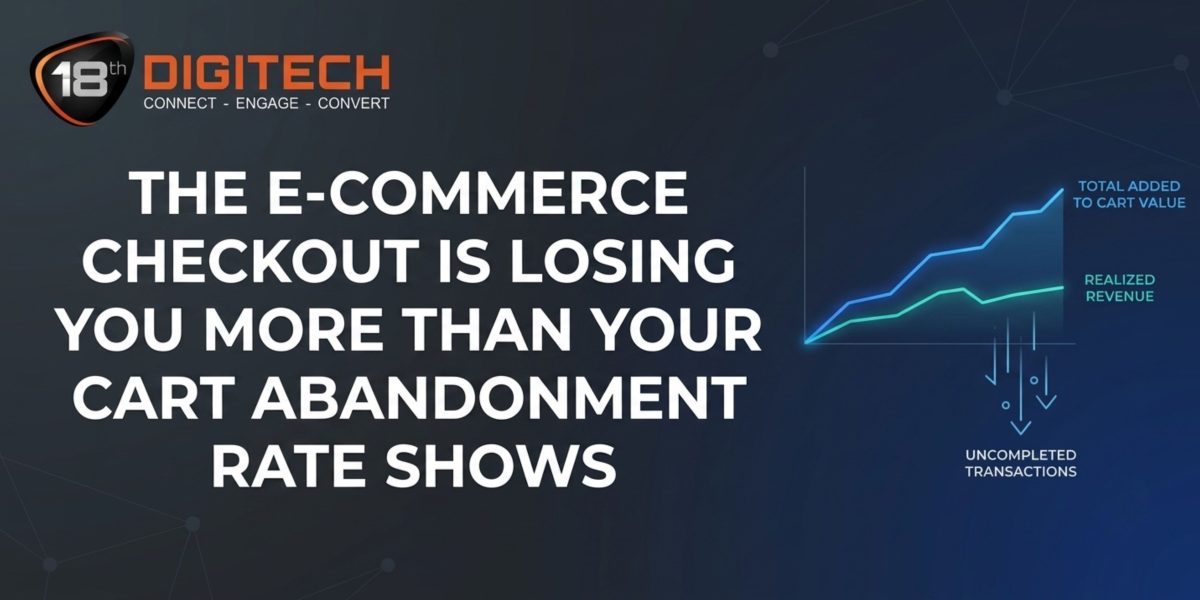
Your cart abandonment rate isn’t your problem. It’s your alibi.
It gives you a number to report, a metric to defend, and a reason to send another recovery email. And while you’re busy optimising that number, the real damage is happening somewhere your analytics aren’t even looking.
Most brands are measuring the last moment a shopper gave up. Not the first moment they started to doubt.
The Leak Isn’t Where You Think It Is
Here’s what actually happens when a shopper leaves.
They didn’t suddenly change their mind at the payment screen. The decision built slowly a page that took too long to load, a shipping cost that appeared from nowhere, a form asking for more than it needed to. By the time they hit abandon, they were already gone.
Cart abandonment is the confirmation. The checkout friction that caused it started three steps earlier. And that’s exactly why fixing your recovery emails will never be enough.
You’re Making a Ready Buyer Work Too Hard
The average eCommerce checkout has nearly 15 form fields. Best practice needs 7.
A shopper has found what they want, decided on the price, chosen to buy and you’re making them fill out a form before they can complete the purchase. Every extra field is a forced decision. Every forced decision is a chance to lose them.
Baymard Institute found that reducing unnecessary fields alone can lift checkout conversion rate by 35%. That’s not a UX improvement. That’s a revenue decision you’ve been postponing. And it doesn’t stop at form fields.
The Small Things Your Team Has Stopped Noticing
Address validation that rejects a flat number. A postcode field that won’t accept the right format. An error message that doesn’t explain what went wrong.
These feel like minor bugs internally. To your customer, they feel like a reason to find a brand that has its act together. This kind of purchase drop-off doesn’t show up dramatically in your reports it just quietly bleeds.
Then there’s page speed. 57% of shoppers abandon if checkout loads slowly. Not crashes. Not errors. Just loads slowly. At the payment step, a lagging page doesn’t just frustrate it signals something might be wrong. Your customer doesn’t wait to find out.
Every second this goes unfixed, your checkout is working against you.
Payment Choice Is Where Brands Silently Lose
69% of shoppers abandon if their preferred payment method isn’t available.
Not because your product wasn’t good enough. Not because of your price. Because there was no UPI. No BNPL option. No wallet they actually use. Online shopping abandonment at this stage is entirely preventable and entirely overlooked by brands that treat payment options as an afterthought.
Buy now pay later isn’t a trend. It’s a purchase decision tool. Brands offering it see higher order values and lower abandonment. The ones that don’t are losing sales to competitors who figured this out two years ago.
Trust Is Seen Before It’s Ever Felt
At the moment of payment, your shopper makes a split-second call.
No SSL indicator. No recognisable payment logo. No security badge. That’s enough for 51% of shoppers to pull back even if they genuinely wanted to buy. Trust signals at checkout aren’t decoration. They’re the difference between a completed order and an abandoned one.
Every reassurance element you place at the payment step is working harder than most of your ad spend ever will.
The Brands Winning at Checkout Are Measuring What Others Ignore
Gut feel doesn’t fix checkout friction. Visibility does.
Adobe Commerce gives you exactly that a clear view of where your checkout funnel leaks. By device. By step. By exact drop-off point. eCommerce checkout optimisation stops being a guessing game and becomes a compounding growth lever. Fix, test, measure, compound.
The leaks exist in every checkout. The only question is whether you can see them.
Stop Measuring the Wrong Thing
You’re not losing customers at the cart. You’re losing them in the details you’ve normalised the slow page, the extra field, the missing payment option, the trust signal that wasn’t there.
The brands closing that gap aren’t guessing. They’re measuring every step, fixing every leak, and compounding every gain.
The real question isn’t whether your checkout has friction. It does. Every checkout does. The question is how much revenue are you willing to leave on the table before you start measuring the right things?