



 About 18th Digitech
 Awards and Credentials
 Our Partners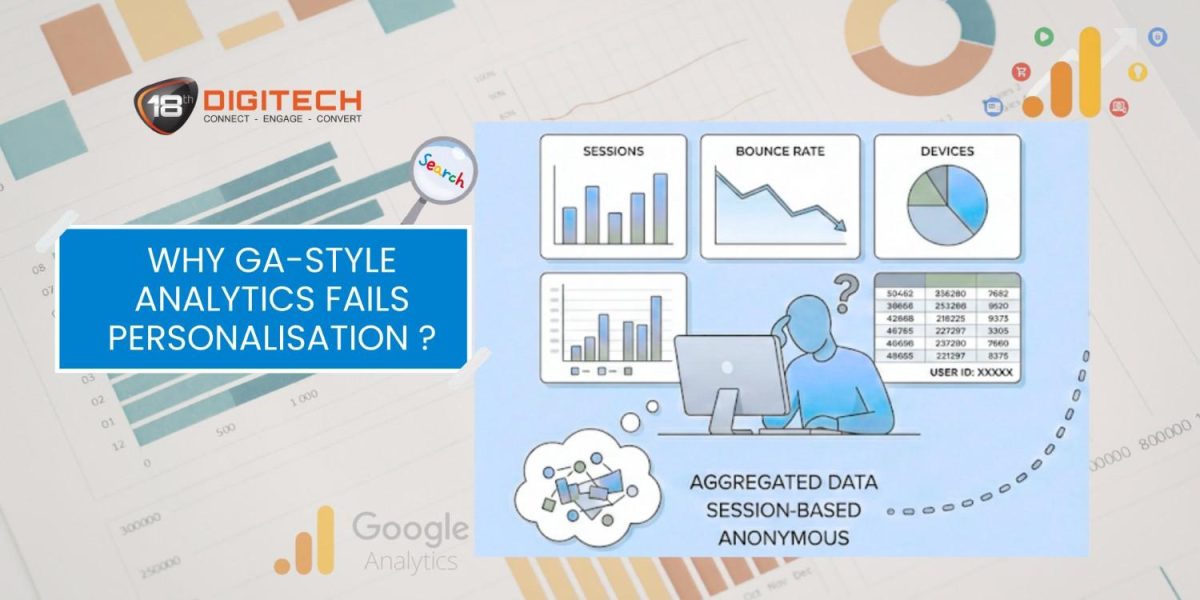
Most personalisation initiatives fail unnoticed. The reason for such results is, quite often, not due to bad ideas or the team’s lack of creativity, but rather to the analytics foundation underneath, which is simply not built for personalisation.
These days, many organisations rigorously try to personalise using analytics models that were never designed or built to support it.
GA-Style Analytics Was Built for Traffic, Not People
As per the design of traditional analytics platforms, they answer a specific set of questions:
- How much traffic did we get?
- Which channel drove the visit?
- What happened in this session?
They work well for monitoring volume and performance, but they struggle when the requirements from them shift from reporting to personalisation. Why? Well, because traditional style analytics are fundamentally designed to be session-centric.
Personalisation, as an operation, requires a different unit of measurement, and it simply does not happen in a single session.
It happens across:
- Multiple visits
- Multiple devices
- Multiple channels
- Known and anonymous states
GA-style analytics resets context constantly.
- A new session
- A new device
- A new cookie
The customer remains constant, but the analytics model keeps evolving. This inherent mismatch disrupts continuity, the very foundation personalisation relies on to remain relevant, consistent, and contextually accurate over time.
Sampling and Aggregation Hide What Matters Most
Personalisation needs precision. It depends on clearly understanding:
- Small but meaningful segments
- Subtle behaviour changes
- Journey-level patterns over time
Sampling, aggregation, and averaging reports make analytics faster and easier to query. However, this efficiency often comes at the cost of depth and reliability in the insights being generated.
When teams cannot fully trust the data at a granular level, hesitation begins to surface in decision-making. Actions get delayed, confidence weakens, and as a result, personalisation efforts gradually stall.
Channel-Centric Views Create Conflicting Truths
In many organisations, different teams rely on different reports to guide their decisions and priorities:
- Marketing optimises channels
- Product optimises flows
- Experience teams optimise journeys
GA-style analytics often reinforces these channel silos. As a result, each channel appears successful when evaluated in isolation, even when the overall customer experience tells a different story.
Personalisation, however, depends on a shared and unified understanding of the customer. When analytics remains channel-centric, building that collective view becomes difficult, and personalisation loses the cohesion it requires to be effective.
Why Personalisation Feels Risky
When analytics cannot confidently explain behaviour, personalisation begins to feel increasingly like informed guesswork rather than a strategic initiative. Uncertainty starts shaping conversations, and teams naturally begin asking:
- Will this actually work?
- Can we prove impact?
- What if the results are questioned later?
As these questions linger, decision-making becomes more cautious and progress slows. Without a person-centric, journey-aware analytics foundation in place, personalisation becomes difficult to scale and even harder to defend internally. Confidence weakens, validation takes longer, and organisational momentum gradually fades.
The issue is not ambition; it is measurement.
Personalisation Needs Analytics That Can Keep Up
To support personalisation effectively, analytics must evolve to:
- Follow people, not just sessions
- Persist identity across touchpoints
- Measure influence over time
- Provide confidence, not just reports
Without this shift, personalisation tools are forced to operate with only a partial view of reality. Insights remain fragmented, context is lost, and decisions are made on incomplete understanding. And partial truth inevitably produces cautious decisions.
The Real Reason GA-Style Analytics Fails Personalisation, it is not because the tools themselves are outdated. It is because the assumptions they were originally built on no longer align with how customers actually behave today.
Personalisation Requires Continuity
Traditional analytics was designed to capture snapshots – fixed moments of activity rather than continuous behavioural narratives. It measures traffic, events, and sessions efficiently, but often misses the broader context in which customer decisions actually form.
Until analytics evolves from traffic measurement to true journey understanding, personalisation will continue to struggle to move beyond controlled experiments and into scalable, sustained impact.